Monday, July 22, 2013

Some (really lazy and insufficient) Reflections on Germany

It has now been over two weeks since I've arrived in England, and while I'm grateful that I can now easily understand people when they speak to me in shops (mostly!) and that I can shed my knee-jerk, apologetic response of "Sorry, mein Deutsch ist nicht so gut," I find myself missing Germany. I feel more comfortable here, of course, largely because I speak the language but also because there are so many pale, pale people here like me (my London-born Bubbie is right when she says I have an English complexion--despite not actually having any real English blood in me, as both of her parents were Polish immigrants). But despite all that, I find myself missing Germany's orderliness, its straightforwardness. And I've found myself needing to adjust to being here now. Even coming face to face with East London's multiculturalism, after spending two months in blond and blue-eyed Germany, has required some re-adjustment. While in Berlin, I heard mostly German, English or Turkish. Here, it's a veritable Babel, in a good way, but it has required me to re-tune my ear again.

Since from hereon out my blog will be moving on from the "Berlin" to cover the "And Beyond" part of my European adventures, I thought that now might be a good time to share some of my reflections on German society and culture, based on the tiny slice of it that I witnessed over my two months in the country.

The best place to start, I think, is with the dogs. German dogs are among the most well behaved dogs I have ever seen. First of all, only the puppies or real delinquents are ever on leashes. The vast majority of dogs trot happily alongside their masters. Or not. Sometimes I would see one fall behind, sniffing something, or go ahead a bit, hot on the trail of something else, but always, always, the dog would constantly be turning around to check on the progress of its human. And people never have to call their dogs to keep up or to stay closer. The dogs just seem to know that it's their job to keep track of where their person is and to ensure that the space between them doesn't stretch too far. It's just...how it is.

In Germany, people take their dogs inside cafes with them. Except if you don't see the dog come in, you may never notice their presence, because they just obediently lie down underneath the table or in an out-of-the-way corner and remain there, despite the tantalising presence of fresh food all around them. They won't move until they're summoned to leave. Or, if left outside a shop or cafe, they'll wait, staring dutifully at the door until their master returns. They don't need to be tied up, they ignore all distractions around them, and they won't budge until given the order to. Illustrating this point quite well is a photo I managed to snag of a dog in Hamburg, left outside a bakery by its human, who had gone inside to buy a coffee:


Not tied to anything, lots of distractions around--lots of traffic and people--but that dog's gaze never left the door of the bakery. But jeez, even if I had a very well trained dog, I think I'd always be so worried about cars that I'd never let him off-lead when on the street. Of course, that's not a problem with German dogs, because, honest to goodness, they automatically stop at every corner and sit down patiently, waiting until their owner comes along and gives them the go-ahead to cross. Seriously. This is something that we tirelessly tried to get our dog to do, but in Germany, they just do it. Mind-boggling.

I recently read this fascinating book by Anna Funder called Stasiland. It was all about the Stasi, the East German secret police, and the iron hold they had over life in the GDR. All that is secondary to my point here. Because Funder, like me, was a non-German living in Berlin and she, too, was apparently struck by the well-behaved dogs. In an off-hand passage in her book, she describes a dog she sees trotting determinedly down a street and remarks, "Somewhere a person must be lost."

I love this, and think it pretty wonderfully sums up German dogs.

For the first six weeks of my sojourn in Berlin, it was a mystery to me and my new-found American friends how these dogs could all be so well trained. It was only during our trip to Hamburg, where we met up with my old friend Lina, that we were actually able to ask a real German person about the dogs. Lina explained that in order to let your dog go off-leash in Germany, you need to take them through a rigorous obedience school. There's some kind of officially recognised certificate that your dog needs to acquire, and without it you must keep them on a leash whenever you step outside with them.

Fine, okay. But the thing is, though, all this super obedience made me feel a bit sorry for the dogs. I mean, is a dog really still a dog if it never gets into mischief, if it's so freakishly well behaved? I mean, I hardly even heard a dog bark while I was in Germany! I wonder what it signifies about German culture, this stark level of obedience that they demand from their pets. Obviously, it speaks to the desire for efficiency and order that Germans are famous for, but does it not also hint at something a little more sinister? Isn't this insistence upon obedience in their pets just part and parcel with the obedience that Germans, at least in days gone by, were expected to demonstrate in all aspects of their lives?

But that's a cynical view of it all. Mostly I just marveled at how amazing those dogs were. Amy and I tried to work out in German how to ask someone if we could pet their dog, but we were too afraid of butchering the language up, as is our wont, and accidentally saying something untoward, so instead we admired all those well-behaved dogs from afar.

So, I just ended up writing a lot about dogs. Sorry about that.

Me and the U-Bahn Berlin Bear at Alexanderplatz. Think of these bears like the moose Toronto had years ago. Each one is painted differently.
How about we change tracks slightly and talk a bit now about that famed German efficiency? I posted that picture above of me with a Berlin Bear painted with the U-Bahn map because it's true what they say: The trains really do run on time in Germany. When I was on my way back from Prague, I started to notice that the clocks at each of the stations we stopped at were, of course, perfectly synchronised, but not only that--they had it down to the minute when the train was arrived. If it was due to arrive at 9:46, you can be sure that it arrived at 9:46 and not a minute earlier or later. How they achieve this insane punctuality I haven't the faintest idea, but this efficiency extends to other aspects of German society, too.

For instance, I don't think Germans are by nature the friendliest people. And this is not because they're unfriendly, so to speak, but simply that they just don't see the point in being friendly. I'm talking about the service industry, of course--the Germans that I encountered in the stores and restaurants I went to during my stay--I know several individual German people who are of course lovely. But when it comes to public, day-to-day life, there is not much room for small talk or even smiles in Germany. You go into a bakery, you wait your turn in line. (God forbid you cut in line, even accidentally.) When it's your turn, the clerk behind the counter will look at you and beckon you by saying "Bitteschoen," which you can basically translate as "Please, it's your turn. Come up here and order, and you better know what you want." So you go, and you order, and you give exact change if you can. You say thank you and then you go. And that's the transaction, done.

On paper it's not so different from at home, but once I went into a bakery and I ordered something (probably it was a pretzel). The guy gave it to me and gave me my change, and as I was putting my change into my wallet and then stuffing my wallet back into my purse, the guy impatiently asked me if that was all or if there was something wrong--all because I was still standing by the counter. There wasn't anyone else in the bakery, or else I would have moved to the side. But even though no one else was waiting, the fact was that I shouldn't have been standing there any more, and that unnerved the guy. Move along, move along. Schnell, schnell.

...

We can talk a bit, too, about race in Germany, but that's a bit of a Pandora's box. The thing is, I have over two weeks of busy activity in the UK behind me already that I need to catch up on here on the blog, and with my sights looking forward towards all of the things I'd like to do and places I'd like to see over the next six-odd weeks, I'm finding it hard to look back on Germany with the focus it deserves. I apologise for this haphazard blog post and its incredibly summary treatment of German society. I assure you that Germany cannot be summed up solely in well-behaved dogs and punctual train service, but I'm afraid that's all I have the patience for right now. Tomorrow I'm off to Bath (!!) and I have lots of planning to do, so I'm afraid I'm just going to leave it here for now.

Also, I decided I'm going to keep a scone count while here in the UK. It's only fitting. I've already had four? Five? Stay tuned.


Wednesday, July 17, 2013

From Berlin...

The last time I came to Germany five years ago, my mother, who is not a big fan of long-distance plane travel, elected not to come along with my dad to visit me. But I made her promise that if I went back to Germany that she would visit me then. And she kept her word, of course. About a week before I had to pack up my things and make the move from Berlin to London, my parents flew out for a visit. I took them crisscrossing over Berlin to all of my favourite sites. Since I've spoken about most them before, it doesn't bear repeating here--I'll let the photos do the talking:

Checkpoint Charlie.
Weißensee in the rain.
And again.
And again, in a brief moment of sunshine.
We went on a quest through the huge cemetery looking for this memorial and grave site containing the ashes of 279 victims killed in German concentration camps, placed there by the Berlin Jewish community during the Third Reich--back when the Nazis would still send the ashes of victims home to relatives, for a fee.
East Side Gallery (on Canada Day--hence my Canuck T-shirt!)
The Jewish Museum. I went again, in search of the Jew in the Box, who once again was not there. Damn it.
Garden of Exile, in the Jewish Museum.
Glassed-in courtyard of the Jewish Museum
A quotation from Primo Levi, marking the entrance of the small, yet powerful, Holocaust museum underneath the Memorial to the Murdered Jews of Europe in central Berlin.
The memorial, with the Reichstag and side of the Brandenburg gate in the background.
Brandenburger Tor!
Corner of the beautiful Deutsches Historisches Museum on a perfect, 23-degree day in Berlin.
The plaque at the book-burning memorial in Babelplatz, by Humboldt University--a haunting, eerily prescient quotation (from 1820!) by the poet Heinrich Heine, which roughly translates to: "Where they have burned books, they will end in burning human beings."
The beautiful Berliner Dom.
Museum Island colonnade.
Bullet-scarred building in the old Jewish quarter.
Security at the Jewish high school.
Memorial to Berlin's Jewish children.
By the memorial.
Old guard tower by the Berlin Wall memorial.
Fields of rye growing by the Berlin Wall memorial.
A church used to stand in the no-man's land between the Wall. The GDR eventually had the church demolished to make room for the death strip. Here's where the church spire toppled.
Reichstag dome.
There were a couple of things I did with my parents that I haven't talked about on this blog yet, so I'll elaborate a little bit more on them.

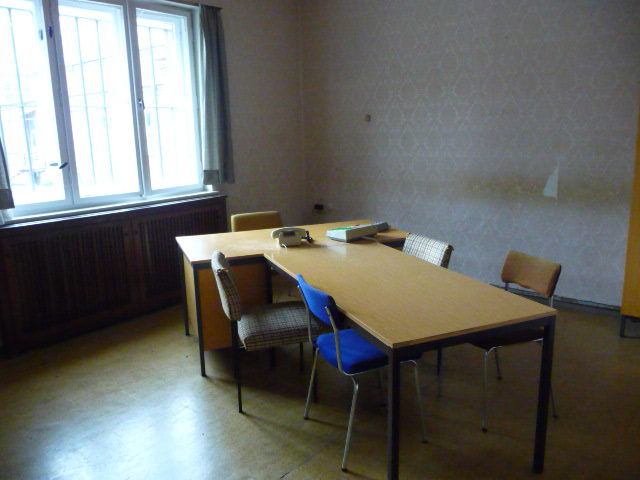
We went to Hohenschoenhausen Prison, the Stasi's (East German secret police) main prison in Berlin, today a haunting museum and memorial. You can only visit the site through a guided tour. Many of the guides are former inmates of the prison, people who were picked up by the Stasi and interrogated and tortured here for anywhere from a few days or several months. Our guide was not one of these former inmates, but rather a Dutch transplant who, appropriately, teaches history in Berlin. He led us through parts of the prison complex, including the infamous "Submarine," a series of cell-lined hallways in the damp, cold basement of one of the buildings. The building was quite old and not watertight--being in the basement, many of the cells constantly had an inch or two of water on the floors, and that doesn't include some of the specially designed cells where particularly reticent prisoners would be immersed sometimes up to their chests in icy cold water for indefinite periods of time.

Basically, it was a nasty, spooky place.

The entire area surrounding Hohenschoenhausen Prison was a restricted Stasi zone. All of the neighbouring buildings were State Security offices and warehouses--one building housed a factory where the bugs the Stasi used to spy on suspected subversives were manufactured. It's worth also saying a word about how the prisoners would be brought to Hohenschoenhausen. Part of the reason for the restricted zone surrounding the prison was so no one would know about the whereabouts of the prison. The Stasi would arrest people without warning and transport them to Hohenschoenhausen, located in the far eastern reaches of Berlin, in a cell hidden within the back of an innocuous looking flower (or sometimes fish or milk) delivery van. The prisoner would be blindfolded and chained, and the driver would take a dizzying route to the prison. Sometimes, our guide informed us, they would drive more than an hour throughout the city or into surrounding countryside before arriving at the prison, just to be sure that the prisoners could have no idea where they were. Upon arrival, the van would drive straight into a garage, so that the prisoners would never even see the outdoor area of the prison complex. Cell windows, where they were any, were blurred and impossible to see through.

Our visit to Hohenschoenhausen offered a fascinating glimpse into the frightening world of the Stasi. The fact that this prison was still in operation within my lifetime sits quite heavily with me.

If you're ever in Berlin, you must go to Hohenschoenhausen. They offer English-language tours once daily, for a very minimal entrance fee. Do it.


A creepy interrogation room. Anyone seen The Lives of Others? It was not filmed at Hohenschoenhausen, although much of the film was set there--apparently there were, unsurprisingly, historical inaccuracies with the script and the director of the Hohenschoenhausen memorial refused to grant permission to film on the site. But anyway, what you don't see in this photo is the stool in the corner that the prisoner would be made to sit on, which was, as in the movie, covered with a piece of fabric, and, as in the movie, the prisoners would be made to sit with their hands underneath their legs, and their sweat would be collected in these pieces of fabric and stored as scent samples in the event of a prisoner's escape.
On a decidedly more upbeat and genteel note, my parents and I travelled the next day to Potsdam to visit the Prussian royal family's collection of rich summer palaces. Potsdam is less than an hour's train ride southwest of Berlin, and you can get there quite easily on the S-Bahn. Of course, the S-Bahn wasn't running all the way to Potsdam on the Sunday morning we decided to go, but fortunately Germany is nothing but well-covered by trains, and you can use the same ticket on any of the regional trains, as well. To make a long story short, we got there after some minor delays. We got off at the wrong station in Potsdam, however, and after a few wrong terms and a failed conversation to get directions with a passerby, I managed to tap into my memory from five years ago and find our way to Sanssouci Park, where the palaces are.

I had been to Potsdam on my previous trip to Berlin with the great people I had met in the program back then. That day trip to Potsdam stands clearly out in my mind as one of the best days I've ever had--everything was perfect from the weather to the company to the majesty of a giant, manicured garden complete with a handful of lovely, ornate palaces. This time around, the company was good and the grounds just as lovely as I remembered, but unfortunately it was quite chilly and made for some brisk walks through the park.

At any rate, here are some shots of the beautiful grounds at Sanssouci Park and the neighbouring cutesy, touristy town of Potsdam:


On our way back to Berlin from Potsdam, we got off the S-Bahn at Grunewald station, located on the outskirts of Berlin, to visit one of my favourite (that's a strange word to use here, but so it is) Holocaust memorials.

Platform 17 at Grunewald station, still very much a small, working train station, was the location from which the Nazis deported most of Berlin's Jewish citizens to the death camps in the East. The Deutsche Bahn (German railroad company) put up the memorial to acknowledge the role the company played in providing trains for the deportations. The track leads to nowhere today, and has been allowed to become overgrown with trees and bush. On the edges of the platform, you can find the basic known information about each transport that left from that location during the war.

Roughly translated as "to remember the train deportations to the death camps by the Deutsche Bahn from 1941 to 1945."
The platform.
Two large deportations in early 1942 to Latvia and Poland.
By 1943, most transports were going directly to Auschwitz.
End of the line.
Roughly translated as: "To remember the tens of thousands of Jewish citizens of Berlin who, from October 1941 to February 1945, were deported by the Nazis from this spot to the death camps, and were murdered there."
So, that's about all of the Berlin portion of my parents' visit! My next post will be about some of my reflections on Germany, and then I plan to write about phase two of my parents' visit--London!

For now, I leave you with this:

In Tegel airport, waiting for our plane to London. Sad to be leaving Berlin...
...but, excited about England!
Oh, and this:

All of the Birkenstocks that I sent home with my parents! Only two of the boxes are mine--the others are gifts!
Annndd this:


Last one, the day before leaving. It ruined my dinner, but to hell with it.
FINAL BREZELN COUNT: 21

(All told, that works out to about two pretzels a week, on average. I think I demonstrated some restraint!)